Optimizing Server Placement for Vertical Federated Learning in Dynamic Edge/Fog Networks
IEEE/ACM Transactions on Networking
2026
Specifically, my work brings distributed and federated learning into the wireless layer, with the goal of making machine learning (and intelligence more generally) a native capability of 6G/NextG systems. My work first establishes the foundation by getting machine learning, both training and inference, to effectively operate over practical networks. I then build on this foundation to create novel learning-native wireless capabilities, such as semantic communications and intelligent beamforming.
The following sections outline the three key directions that I take towards realizing my vision of federated intelligence for AI-native wireless communications. Each section also highlights selected publications. For a full list of publications, see here.
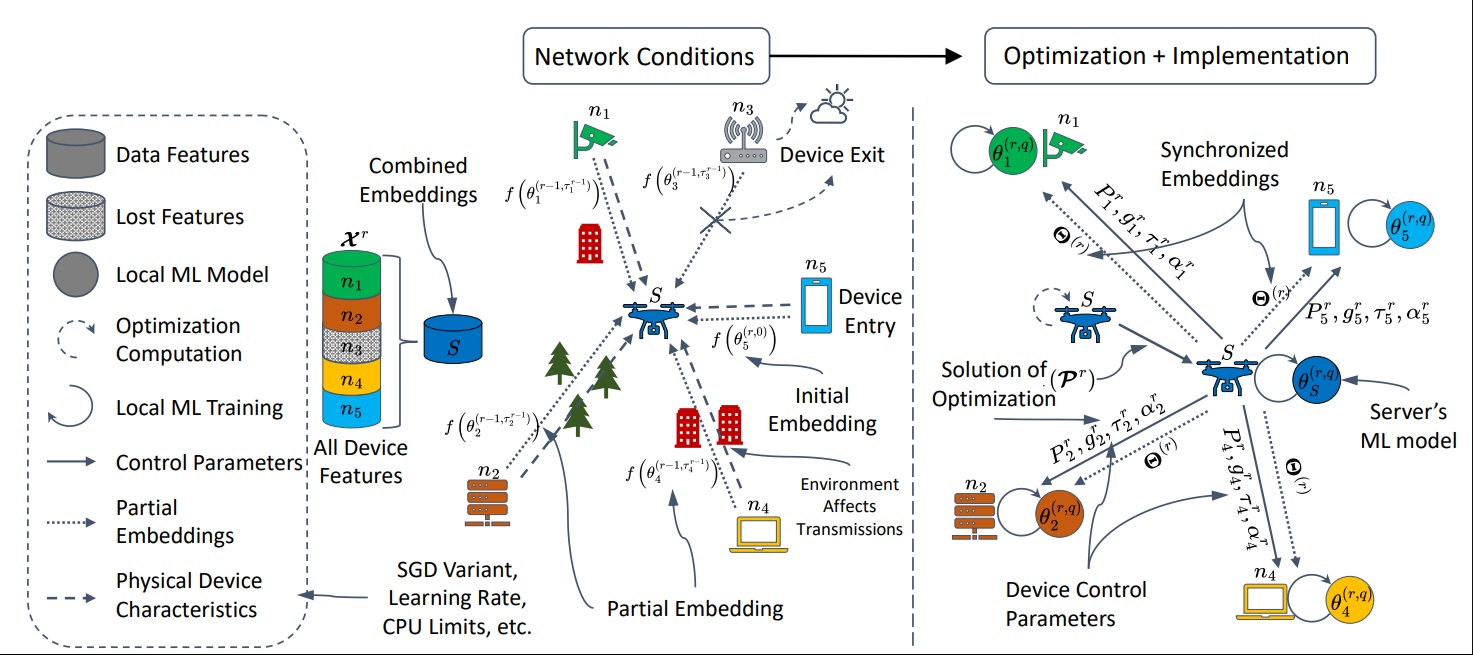
Distributed and federated learning approaches have become popular techniques to enable training and inference of ML models (collectively, machine intelligence) across practical edge/fog networks. The coupled forms of heterogeneity inherent to such networks (e.g., computation and communication differences as well as unique local dataset statistics) require novel approaches that reshape both how models train and how they are served. Improper treatment can lead to degradation of task performance while simultaneously inflating resource costs on edge/fog networks.
My work aims to understand the relationships between performance versus resource costs under extensive network heterogeneity, across the full cycle from (federated) training to (collaborative) inference. On the training side, my recent work develops control and optimization methodologies for understudied forms of edge/fog heterogeneity, e.g., data-feature heterogeneity in dynamic networks, and proposes novel techniques such as device-to-device cooperation to inform intelligent device sampling. Most recently, my emerging work has begun to explore performance–resource balancing across edge–cloud systems to enable LLM inference. Experimentally, these proposed methodologies yielded up to 50% improved resource efficiency, while even offering performance improvements.
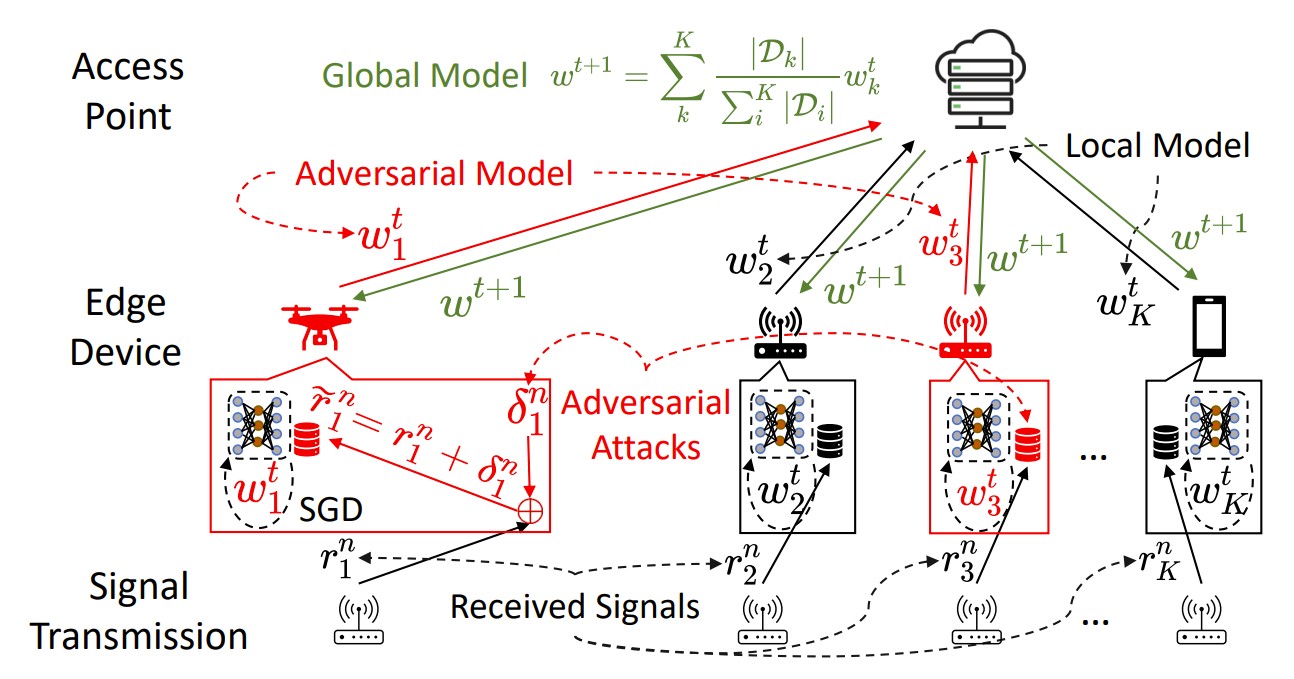
The growth of ML alongside that of edge/fog device communications is unlocking new capabilities for wireless networks, such as semantic communication or automatic modulation classification. Neither the extent of these capabilities nor the core principles underlying them are yet well understood. Thus, there are opportunities to establish what machine intelligence native to 6G/NextG systems should look like. To do so, we must also contend with the distributed nature of such systems, which feature varying computation, data statistics, and channel conditions across network devices.
I am developing methodologies that pair learning with wireless systems. In the following representative works, I have investigated holographic beamforming for semantic communications, where reconfigurable surfaces are paired with ML encoders/decoders to shape transmissions. Additionally, I have introduced FL methodologies for signal classification, characterizing them in the presence of evasion attacks crafted at the physical layer. Most recently, I have sought to further develop AI-native wireless systems, by adapting concepts from federated systems towards distributed beamforming.
Alongside these two threads, I have been working on emergent directions of distributed/federated intelligence and wireless systems. Here, I have focused on advising mentees, including undergraduates at Princeton and Ph.D. collaborators at various institutions, in two main directions: (a) distributed and federated intelligence as a foundation for general cyber physical systems and (b) practical applications of machine learning, specifically federated unlearning and fast implementations on low-cost hardware (e.g., commoditized MCUs).